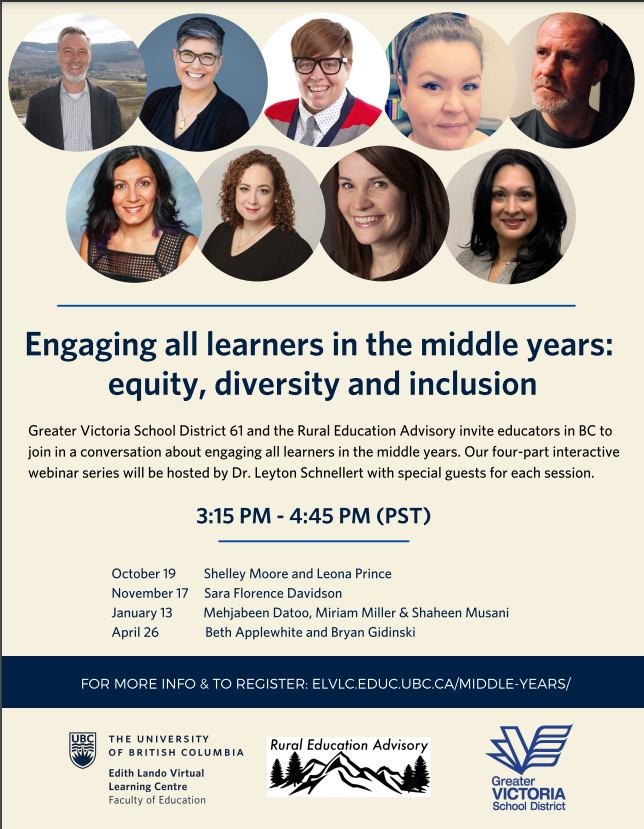
I have been participating in a four-part interactive webinar series called Engaging all learners in the middle years: equity, diversity and inclusion. It has been put on by the Greater Victoria School District 61, UBC and the Rural Education Advisory. Each session has special guests who talk about education, inclusion, resources and diversity.
Session, one had Shelley Moore and Leona Prince presenting.
I have attended a few workshops with Shelley and always find her information thoughtful and interesting. She is big on inclusion which I agree with and will strive to have in my classroom. She said there needs to be a shift in thinking about disabilities. Resources need to support everyone in the classroom, not just the student with an IEP. The IEP communicates what the barriers are for the learner and what the needs are. The support and strategies could be applied to everyone in the classroom community. Why single out one person for using a resource when others might benefit from the use as well? Shelley says we need to fix the deficit and remove the barriers so that all students can be successful in the classroom with their peers.
Leona Price is a District Principal of Aboriginal Education for School District 91 (Nechako Lakes) and an author. She is Indigenous and brings knowledge on equity and Indigenous Pedagogy. We need to honor people for their strengths because we work in a community of learners and working together builds relationships. She focused on the connection to the land, land-based learning, and sustainability which is embedded through values. Leona, also mentioned the importance of local land knowledge. Walking the land so that stewardship can be seen/used, telling stories from the land, restoring self from the connections to the land, speaking on behalf of the land allows for the values of the land to be recognized. Our biggest gap in equity is our mindset. When we as educators are able to deconstruct our mindset, we can honor who a person is and then speak to inclusion, diversity, and equity. For inclusion education to happen, the barriers need to be broken down and there needs to be communication.
Session two was Sara Florence Davidson
Sara spoke on bringing Indigenous voices into the classroom. I found this session very informative because Sara spent the time talking about how to review Indigenous resources that we bring into our classrooms. The resources that come into the classroom need to be respectful and will work for those students that year. Each year the resources need to be reviewed to see if they will work with the students or if new ones need to be added. Her main questions to ask/think when looking to use an Indigenous resource in the class are:
– Who developed the resource
– How are Indigenous Peoples represented in the resource
– Does the resource contain traditional Indigenous stories
– Does the resource contain Indigenous art
– Does the resource contain references to or depictions of ceremonial information
– Does the resource honor the diversity of Indigenous Peoples
– Does the resource portray Indigenous Peoples authentically and accurately
Sara also went on to talk about being story ready and the Indigenous Story Work Principles that Dr. Joanne Archibald has created. Being story ready involves:
-respect, deep listening
-responsibility, accuracy
-reverence, holding stories gently
-reciprocity, giving back by sharing with others to ensure the knowledge continues
There is a sense of holistic engagement with stories and students need to be in a space of readiness to hear the story. The four areas of engagement are mental (listen to the story), physical (drama activities, movement), emotional (reflect on the story) and spiritual (teachings from the story). You want the students to make connections to their life, experiences they have encountered, and what we can learn from the characters or events from the story. Sara concluded her presentation with showing us resources that are authentic and can be used in the classroom. Some of the books she showed us, I already have and hopefully will be able to use them in my practicums. Sara also provided a list of resources and websites that we could check out when looking for resources for lessons.
Session three saw three presenters Mehjabeen Datoo (Subtle Shifts: Rethinking Social Studies), Miriam Miller (SEL) and Shaheen Musani (Embracing the Mindset of Cultural Humility)
Mehjabeen talked about choices when it comes to picking different units of study we want to include when we plan units for the school year. She talked about how textbooks, social studies, have a disproportion of areas/chapters of information, why is there only one chapter on India but three chapters on China? She also went on to say that newer edition textbooks are starting to change and have more questions, chapters, and voices included. The information in textbooks is starting to expand our notions of the world to see history as a set of interconnected forces and not just as individuals. She made the suggestions that when we teach, we should intergrade our own sources of information and seek out additional sources that support the material you want to teach.
Miriam talked about how Social, Emotional Learning (SEL) helps build students’ skills for success but that it is a missing piece in education. SEL can be about compliance, behavior management and classroom management. SEL can also be seen as necessary skills for students to function and at the same time, be seen as career readiness for students at more advantaged schools. Miriam noted that SEL skills are needed for students to understand one’s own emotions, thoughts and values and how they influence their behavior across contents. Miriam went on to say that we as teachers need to reimagine SEL as a way of being that influences all aspects of teaching and learning and that SEL becomes developed within a safe community where relational trust is built, and vulnerability is safely welcomed. Transformative SEL can:
• Connect students’ cultural assets and resources to academic concepts and skills
• Uses curricula that encourage student reflection on their own lives and society
• Supports students’ cultural competence by facilitating learning about their own and other cultures
• Pursues social justice through critiques of discoveries of power
Finally, when teachers are planning their instruction, they need to think how will my instruction help students learn something about themselves or others and how do I focus on the beauty and brilliance of the youth in my class.
Shaheen talked about the characteristics of mindset (humility); respect for others, awareness of social power imbalances, and continuously reflecting on your biases. The connection to self, community and considering world views and perspectives all comes from the mindset of cultural humility. Unit planning needs to have flow and teachers can plan for this by having activities that explore, share, read, analyze, and critique. Shaheen’s information was based more for high school teachers and students but I can see incorporating the flow of ideas for unit plans into my own lessons so students can make connections and the material they are learning is meaningful to them.
Leave a Reply